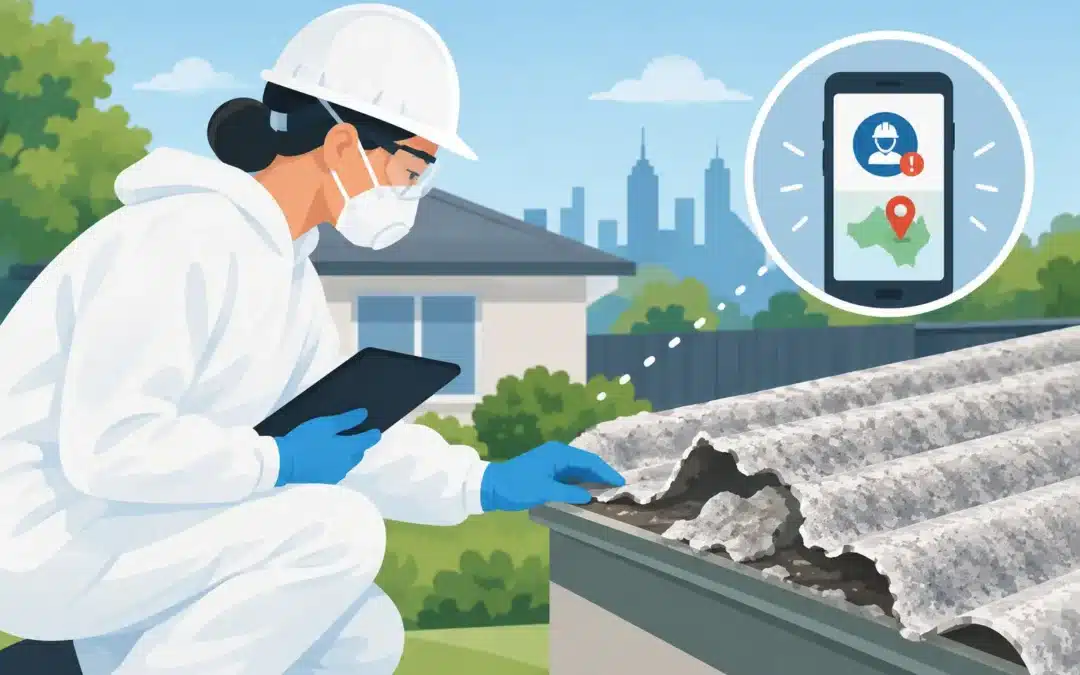
A broken grey cement sheet beside a fence, damaged eaves after a storm, or crumbling insulation in an older building should never be treated as ordinary building waste. Knowing how to report damaged asbestos quickly can protect your family, workers, neighbours and the wider community from unnecessary exposure.
In Victoria, asbestos is still common in buildings constructed or renovated before 1990. Many materials remain safe when they are intact and left alone. The concern starts when asbestos-containing material is cracked, drilled, weathered, burnt, dumped, crushed or disturbed. The right response is to stop access, avoid creating dust and report the problem to the correct authority or responsible party.
First, treat the material as suspected asbestos
You cannot confirm asbestos by looking at it alone. Cement sheeting, roofing, eaves, wall linings, vinyl floor backing, pipe lagging and old insulation can all contain asbestos. If a material is from an older property and has been damaged, the safe approach is to assume it may contain asbestos until it has been professionally assessed or sampled.
Do not break off a piece for testing yourself. Do not sweep debris, use a household vacuum, hose the area down or place fragments into your wheelie bin. These actions can spread fibres through the air, soil or surrounding surfaces.
If the material is indoors, keep people out of the room, close the door if it can be done without touching the damaged material, and switch off nearby heating, cooling or ventilation if practical. If it is outdoors, keep children, pets, workers and vehicles away from the area. A simple barrier or clear warning can help, provided you can put it in place without handling the asbestos.
How to report damaged asbestos in an emergency
Call Triple Zero (000) where damaged asbestos is creating an immediate risk to people or property. This may include a fire, storm damage with widespread debris, a traffic incident involving suspect asbestos waste, or material scattered in a public place where people cannot safely be kept away.
Tell the operator that suspected asbestos has been damaged or released. Give the exact location, explain what has happened and advise whether anyone may have disturbed the material. Emergency services can manage the immediate danger and coordinate the appropriate response.
For non-emergency situations, do not assume the material will be collected simply because it has been reported. The responsible authority depends on where it is located, who controls the site and whether it is a workplace, private property or illegal dumping incident.
Report it to the right person or authority
On a private residential property, report damaged asbestos to the property owner, landlord or body corporate if you are a tenant or live in a strata-managed building. If you own the property, arrange a professional asbestos inspection or engage a licensed asbestos removalist to assess the damage and provide advice on safe removal, containment and disposal.
At a workplace, notify the site manager, employer or health and safety representative immediately. The area should be isolated while the person with control of the workplace arranges a competent assessment. Employers and site managers have duties to manage asbestos risks, particularly during maintenance, demolition, fit-outs and emergency repairs.
If the damage occurs on public land, such as a nature strip, reserve, footpath, laneway or roadside, contact the relevant local council. Councils are generally the first point of contact for suspected asbestos illegally dumped in public areas and can organise an inspection or make the site safe.
For illegal dumping, contamination or a pollution concern that requires environmental reporting, contact EPA Victoria. Provide the location, details of the material and any information about vehicles or people involved, but do not approach anyone dumping waste or attempt to investigate the source yourself.
Where the material is on a construction, industrial or commercial site, the principal contractor or site manager should assess whether the incident must also be reported to WorkSafe Victoria. Notifiable incidents have strict requirements. If there is any uncertainty about the scale of exposure, the condition of friable asbestos, or the reporting obligation, get professional compliance advice straight away.
Give useful information without putting yourself at risk
A clear report helps the responsible party respond faster. You do not need to become an investigator or get close to the material. From a safe distance, make a note of the address or nearest landmark, the time you noticed the issue and whether the material is indoors, outdoors, buried, burnt or spread across a wider area.
It is also useful to describe what caused the damage. For example, it may have been storm debris, demolition activity, vandalism, a vehicle impact, renovation work or dumped rubbish. Explain whether people have walked through the area, whether dust is visible, and whether the material is near a school, childcare centre, drain, garden, public path or air-conditioning intake.
Photographs can support a report, but only take them from a safe location. Do not climb onto a roof, enter a restricted work area, move debris for a better image or put yourself in the path of traffic. If you see a vehicle involved in suspected dumping, record the registration, make, model and direction of travel only if this can be done safely.
Damaged bonded asbestos and friable asbestos need different responses
Not all asbestos materials present the same level of immediate risk. Bonded asbestos is commonly found in cement sheeting, fences, roof cladding and eaves. The asbestos fibres are mixed into a hard cement-like product. When it is intact, it is generally lower risk. Once badly broken, drilled, cut, sanded or weathered, it still needs careful handling because debris and dust can be released.
Friable asbestos is more easily crumbled by hand pressure and can release fibres more readily. It may be found in older pipe lagging, loose-fill insulation, fire doors, insulation board or sprayed coatings. Suspected friable asbestos should be treated as urgent. Keep well clear, prevent access and arrange an immediate assessment by appropriately licensed professionals.
In Victoria, asbestos removal licensing requirements depend on the type and amount of asbestos involved. Any friable asbestos work requires a Class A licensed removalist. Larger quantities of non-friable asbestos also require licensed removal. Trying to save time or money by handling damaged material without the right controls can create a much bigger clean-up, compliance and health problem.
Do not clean it up before advice is received
Property owners often want to make the area look tidy straight away, especially after a storm or renovation mishap. This is understandable, but asbestos clean-up is not a normal rubbish removal job. Sweeping, blowing, pressure washing and vacuuming can spread contamination well beyond the visible fragments.
Keep the area undisturbed while you wait for instructions. Do not allow trades to continue work nearby, and do not let gardeners, cleaners or maintenance staff move material unless they are properly trained, equipped and authorised for the task. If dust or debris may have travelled through an occupied space, professional decontamination advice may be required before the area is used again.
A qualified assessor can identify the likely material, arrange testing where needed, define the extent of contamination and recommend the right removal method. A licensed contractor can then remove, transport and dispose of asbestos waste at an approved facility, with the paperwork and controls required for the job.
What to expect after making a report
The response will depend on the location and level of risk. Council or an authority may inspect public dumping, secure the area and arrange removal. A workplace may stop work, inspect the affected zone and bring in an occupational hygienist or licensed asbestos contractor. At home, the property owner may need an asbestos assessment before repair work can begin.
Fast action matters, but the best response is not always the fastest person with a ute and a skip bin. The right provider should understand Victorian asbestos requirements, use suitable containment and waste controls, and explain exactly what will happen before work starts.
For Melbourne and Victorian property owners, builders and facility managers, Asbestos Audits Australia can provide practical advice, professional assessment and licensed asbestos services where damaged material needs to be managed properly. Good old fashioned service means answering the phone, explaining the options clearly and treating every site with the care it deserves.
When asbestos is damaged, a calm report and a properly controlled response are far more valuable than a quick clean-up. Keep people clear, report the hazard, and let qualified professionals take it from there.